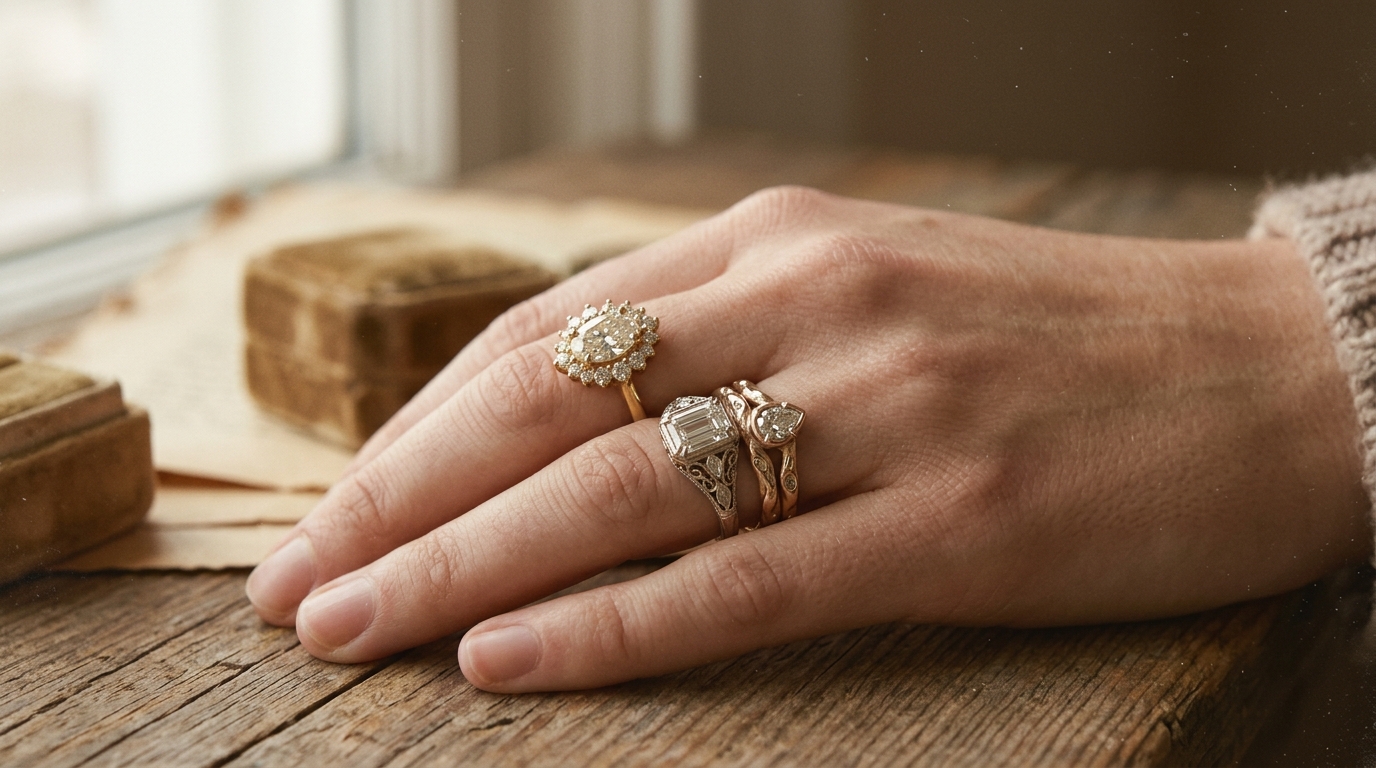
Unusual Shapes and Settings: Marquise, Emerald Cut and East-West
Ask most people what makes engagement rings unique, and they’ll point to the center stone’s shape. Round and oval dominate, so stepping away from them is the fastest route to a ring that doesn’t look like everyone else’s. Barkev’s 2026 trend report puts round at about 26% of rings and oval at about 25%, with emerald, pear, marquise and princess each hovering near 8%. That’s a vendor-compiled number, so treat it as a rough guide. Still, it tells you something: a marquise or an emerald cut really is an uncommon choice.
The emerald cut is a rectangle with clipped corners and long, stair-step facets. You won’t get the glitter of a brilliant cut. What you get is broad flashes of light and a clean, almost architectural look. The catch is that step cuts show inclusions more readily than brilliant cuts, so clarity matters more than most people expect. That’s general gemological knowledge, and a good jeweler will let you examine the stone under magnification rather than ask you to take it on faith. Settings run from a plain solitaire to a halo, bezel, three-stone or vintage-inspired mounting, and emerald cut ring styles vary enough that two of them can look nothing alike.
The marquise is the dramatic one: a long, pointed oval that elongates the finger and looks larger per carat than a round. Some sources say it can cost 10–20% less per carat than an oval, though that’s a vendor claim and varies stone to stone. Its weak spot is those two sharp tips, which chip easily. V-prongs or a bezel are the usual advice for everyday wear, and a halo adds a buffer around the points. A poorly cut marquise can also show a dark "bow-tie" shadow across the middle, so check the cut in person.
East-west orientation is the simplest way to make an elongated shape feel new. Turn an emerald, oval or marquise sideways so the long axis runs across the finger, and the same stone suddenly reads as modern, even a little rebellious. Bezel settings and hidden halos, where a ring of small diamonds sits beneath the center stone and shows only from the side, are other quiet ways to stand out. To see what’s possible, our engagement ring collection lets you compare these shapes and settings side by side.
Colored Stones Like Sapphire: Beauty, Color and Real Durability
Sapphire is the colored stone people ask about most, and it earns the attention. It comes in blue, pink, yellow, green and even white. Blue has long stood for wisdom and sincerity, pink for love and compassion. It also rates 9 on the Mohs scale, just under diamond’s 10, which makes it a practical pick for a ring worn daily. Emerald and morganite land around 7.5 to 8.
Keep that number in perspective, though. The Mohs scale measures only scratch resistance, and it isn’t evenly spaced: diamond at 10 is far harder than sapphire at 9, not merely a step ahead. Hardness also isn’t toughness, which is a stone’s ability to survive a knock without chipping or fracturing. One vendor cites the Young Durability Scale, which weights fracture toughness at 45%, but that claim comes from a seller, so take it with caution. The practical takeaway: sapphire is very resilient and a sensible everyday stone, but a hard blow to a thin setting can still damage it. A protective mounting matters.
Ask about treatment, too. Many sapphires are heat-treated to improve color. That’s standard and widely accepted in the trade, but it should be disclosed, and it can affect how you clean and care for the stone. Prices swing widely with color, clarity and origin. One vendor says sapphire runs 30–50% below diamond, but that figure is unverified, and a fine, saturated stone can cost far more than a pale one. Look at the stone in daylight as well as under shop lighting, since color can shift noticeably between the two.
Colored stones also pair well with other metals. Rose gold, chosen for its warm, romantic feel, flatters pink and champagne sapphires especially. If you want meaning beyond a center diamond, a sapphire solitaire, or a diamond ring with sapphire side stones, gives you color and a story together. Browse ideas in our bridal collection, and ask us to source a particular hue if you don’t see it.
Custom Versus Ready-Made: What Unique Rings Really Cost
Cost is where most people hesitate, so start with the national picture. The Knot’s 2024 study put average US engagement ring spending at about $5,200, and other studies land closer to $6,500. One jeweler cites a later report saying the average fell to $4,600 in 2025, though we couldn’t verify that on The Knot’s own site. According to Goodstone’s 2026 cost breakdown, carat, metal and whether the diamond is lab-grown or natural all move the price substantially. As reported by The Knot, natural diamond rings average about $7,000 at 1.6 carats, while lab-grown rings average about $4,300 at a larger 2.0 carats.
Custom work isn’t automatically a luxury tier, but it does add steps. Published ranges differ by jeweler and region: one source says $2,500–$12,000, another $1,500–$7,000, another $3,000–$15,000. These are vendor figures from other markets, so use them to understand the shape of the cost rather than as a quote. The usual pattern is that the custom setting runs roughly $1,500–$5,000, the center stone makes up about half to three-quarters of the total, and a design or CAD fee of a few hundred dollars may apply, often credited toward the final purchase.
So does custom cost more than ready-made? Often, but not always, and the comparison is rarely apples to apples. A ready-made ring is faster and its price is fixed, which is ideal when a proposal is around the corner. A custom ring lets you spend where it matters to you: a better stone with a simpler band, or a modest stone in an unusual setting. Reusing a family stone can shrink the budget a lot, since you’re paying mainly for the new mounting.
Timeline is the other tradeoff. Custom pieces move through consultation, design review and crafting, so they need more lead time than something pulled from the case. If you’re up against a proposal date, tell us early. Sometimes the best answer is a ready-made ring with one small custom touch, like a personal engraving or a swapped-in stone.
How Custom Design Works at Adam’s Jewelers in Roseville
We’re a family-run shop in Roseville, and our approach is simple: you walk in as a customer and, we hope, leave as a friend. We custom-design one-of-a-kind jewelry, and the process feels like a conversation, not a sales pitch.
Most custom projects follow a familiar path across the trade: a consultation, a 3D model or sketch, stone selection, a design review before anything is cast, then crafting and final delivery. We begin by listening. What does your partner wear now? What would they never wear? How active are they, and what budget feels comfortable? From there we talk through shapes, metals and settings, and we can pull stones for you to compare in person. Seeing a marquise and an emerald cut side by side on a real hand often settles the debate faster than any photo.
We also carry designer lines that make good starting points, including Bellarri, Barkev’s and Galatea, and our own Adam’s bridal collection offers ready-made pieces you can customize. Financing plans are available if you’d rather spread the cost. Because we handle on-site jewelry repair and appraisals, you can also bring in a family stone or a ring you want reworked and get honest advice on what’s feasible. We’d rather tell you a design won’t hold up than sell you something that chips in a year.
If your timeline is tight, say so at the first visit. We’ll tell you straight whether a fully custom piece is realistic or whether a ready-made ring with a personal tweak is the smarter route. Customers come to us from Roseville, Rocklin, Granite Bay, Folsom, El Dorado Hills, Fair Oaks and across the Sacramento area, so a quick visit to look, touch and ask questions is easy to arrange.
How to Choose a Unique Ring You’ll Love Every Day
A ring that photographs well isn’t necessarily one that suits daily life, so build your decision around a few concrete criteria rather than trends alone.
- Lifestyle first. If your partner works with her hands, climbs, or is hard on jewelry, favor a protective setting like a bezel, and think twice about exposed marquise tips. A low-profile mounting snags less on clothing and gloves.
- Stone durability. Sapphire at 9 on the Mohs scale is a strong everyday colored stone, while softer stones like emerald or morganite need more careful wear. Ask about any treatments and how to care for them.
- Clarity and cut quality. Emerald cuts reveal inclusions, and a marquise should be checked for a bow-tie shadow. Look at the actual stone, in different light, before you commit.
- Budget and where to spend it. Decide whether you’d rather invest in the center stone, the setting or the metal, and remember that lab-grown stones can stretch a budget considerably. Don’t feel bound by the old "three months’ salary" rule; several guides explicitly advise skipping it.
- Timeline. Custom work takes longer than ready-made, so match your approach to your proposal date.
- Personal meaning. A birthstone, a family stone, rose gold’s warmth or an engraved message can make a modest ring feel priceless.
Still undecided? Start with the styles that simply feel like her, then narrow by durability and budget. Browse our engagement rings or wedding sets for inspiration, then stop by and we’ll help with the next step. The right choice among engagement rings unique to your story is the one she’ll reach for every morning without thinking twice.