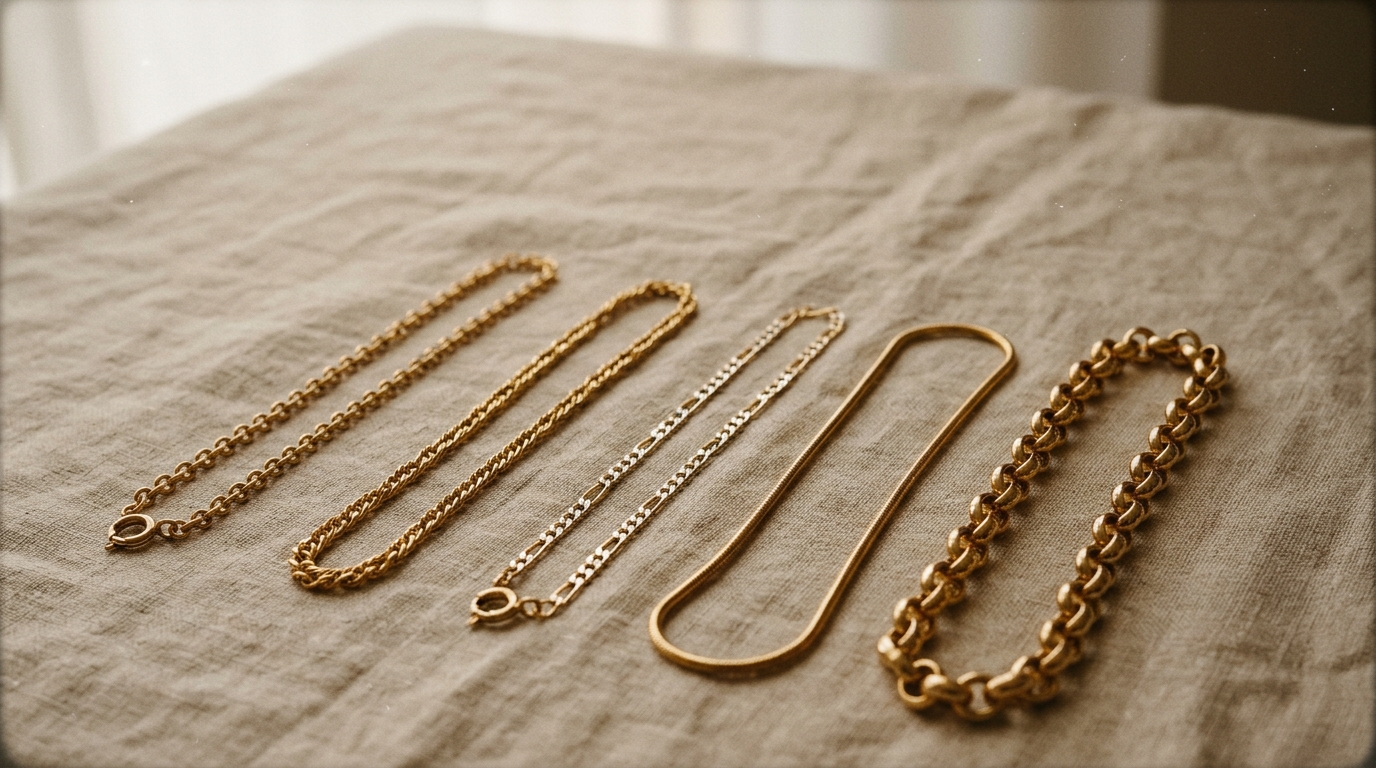
Popular Necklace Chain Types and Their Looks: Cable, Box, Rope, Curb, Figaro, Snake, Herringbone, and Other Common Styles
Stand at any jewelry case for a minute and you’ll see that a chain does more than hold up a pendant. The shape of the link changes how a necklace catches the light, how it lies against your collarbone, and how it holds up to daily wear. Here’s a plain-language tour of the types of necklace chains people ask us about most.
Cable chains are the classic: simple oval links, each one threaded through the next. They’re versatile and understated, and most pendants are sold on one. If you picture a "regular" necklace, you’re picturing a cable chain. Its close cousins, the trace and anchor styles, use similar oval links with small variations.
Box chains are built from tiny square links that give a smooth, geometric look. They sit neatly and read as clean and modern, which is why they’re a favorite for carrying a small diamond or charm.
Rope chains twist their links into a spiral that looks like a miniature braided rope. The twist throws light in every direction, so they sparkle, and they make an eye-catching necklace on their own. Rope construction is quite old, and the history of the rope chain is worth a read if you like the story behind a style.
Curb chains use flat, twisted links that lie flush against each other. They’re sturdy and confident, popular in both men’s and women’s jewelry, and the heavier versions make a bold statement.
Figaro chains repeat a pattern, usually several short links followed by one long one. That rhythm gives them a distinctive, slightly vintage personality.
Snake chains are made of tightly connected, squared segments that form a smooth, flexible tube. They feel almost like liquid metal on the skin, though they’re less forgiving if bent sharply.
Herringbone chains are flat and mirror-like, with tiny angled links lying side by side. They’re shiny and gorgeous, and best worn solo as a polished accent rather than asked to carry a heavy charm.
A few other styles turn up often:
- Wheat chains: interwoven links that resemble a stalk of wheat.
- Byzantine chains: an intricate, woven look with real visual depth.
- Ball (bead) chains: tiny spheres spaced along the chain, playful and lightweight.
- Paperclip chains: elongated flat links, very popular for a trendy, layered look.
- Mariner chains: links with a center bar, inspired by anchor chain.
- Franco and Cuban link chains: chunky, interlocking styles that lean bold.
Any of these can be made in gold, white gold, platinum, or sterling silver, so the same silhouette can feel casual or dressy depending on the metal.
Chain Durability and Pendant Compatibility: Comparing Chain Types at a Glance
Shoppers asking about types of necklace chains usually want to know two things: which one is strongest, and which one will carry a pendant without trouble. Honestly, it depends on a chain’s thickness and construction as much as its style, but some patterns hold up.
Here’s a quick comparison of types of necklace chains. Treat it as a rule of thumb, not a guarantee, since individual chains vary by weight and maker.
| Chain type | Overall look | Durability | Pendant friendliness |
|---|---|---|---|
| Cable | Classic, simple | Good, depends on thickness | Excellent |
| Box | Clean, geometric | Good | Excellent |
| Rope | Textured, sparkly | Strong for its weight | Good, great solo |
| Curb | Bold, flat-lying | Strong | Good |
| Figaro | Rhythmic, vintage | Good | Good |
| Snake | Smooth, sleek | Moderate; can kink | Fair |
| Herringbone | Flat, mirror-like | Delicate; can kink | Best worn solo |
| Wheat/Byzantine | Woven, ornate | Good | Fair to good |
Several of the sources we reviewed agree that box, curb, and Cuban-style links tend to be among the sturdier choices for holding a pendant, while herringbone and fine snake chains are the ones most likely to bend or kink. Rope often gets praised for its strength relative to its weight.
One point deserves more attention than it usually gets: thickness often matters more than karat. A very thin chain in a higher karat can fail before a thicker chain in a lower karat, because higher-karat gold is softer. For everyday wear, a slightly sturdier gauge is usually a smarter buy than chasing the biggest karat number. That’s the kind of value advice we’re glad to talk through at the counter.
For a delicate pendant, a fine cable or box chain keeps the focus on the stone. For something heavier, step up to a thicker link so the chain and pendant feel balanced instead of mismatched. If you’d like a ready-made pairing, our pendants and floating diamond necklace collection shows how a light chain lets a stone take center stage.
How to Choose the Right Chain: Matching Style, Metal, Weight, and Length to Your Needs
Choosing among types of necklace chains gets easier once you work through four questions: what you’ll wear it for, what metal suits you, how much weight you want, and how long it should hang.
Start with purpose. If the chain will carry a pendant or charm, lean toward cable, box, or a sturdy curb. If it’s meant to be the star, rope, Figaro, paperclip, or a chunkier curb can stand alone. For everyday wear, simple, durable styles earn their keep because they put up with constant movement.
Consider the metal. Yellow gold is warm and traditional. White gold and platinum look cool and bright, and they pair well with diamonds. Sterling silver is affordable and classic, though it needs a bit more polishing over time. If you have sensitive skin or plan to wear a chain every day, ask us about metal options, since comfort matters as much as looks.
Think about weight and width. A fine chain is graceful but more delicate. A wider, heavier one makes a statement and generally resists wear better, though you’ll notice it more. Try a few against your neck, because a width that looks right on a display bust can feel different on you.
Pick a length that flatters. A shorter chain sits at or near the collarbone, a mid-length falls a little lower, and a longer one drapes toward the chest. The right choice depends on your neckline, your pendant’s size, and how you like to wear it. Holding a chain up to the mirror beats guessing every time.
Still not sure? Come see us. Trying chains on in person is the fastest way to know what feels like you, and we’re happy to pull several styles side by side so you can compare. Browse our chains to get a feel for the range before you visit.
Layering Chains and Customizing Length: Stacking Styles and Custom-Made Options
Layering has become one of the most popular ways to wear necklaces, and it’s a lovely way to get more out of the types of necklace chains you already own. The trick is variety with intention.
Mix textures, not just lengths. A flat chain like a paperclip or herringbone looks great beside a rounder one like a cable or rope, because the different shapes catch light differently. Stagger the lengths by an inch or two so each strand has room to be seen instead of tangling into the next.
Anchor the stack with a focal piece. Many people pick one pendant or statement chain and surround it with simpler, finer strands. That keeps the look curated rather than cluttered. For a starting point, try a delicate pendant on a light chain next to a slightly bolder solo chain.
Keep clasps and weights in mind. Layers of very different weights can shift and twist. Chains with a similar hang sit better together, and putting a thinner strand closest to the neck helps the stack settle properly.
As for whether chain length is fixed: it doesn’t have to be. Many chains can be adjusted, and when you want something specific, custom-made options are available. Because we design one-of-a-kind jewelry, we can talk with you about building a chain in the length, link style, and metal you have in mind. Availability and current policies can vary, so ask us in the store what’s possible for your project. If personal touches appeal to you, our personalized jewelry selection is a good place to begin.
Caring for and Repairing Your Chain in Roseville and Sacramento: Link Repair, Resizing, and In-Store Help
Even a well-chosen chain among the types of necklace chains deserves a little care, and sooner or later most of them need a small repair. The good news is that a broken link, a worn clasp, or a chain that’s the wrong length is usually fixable.
A few habits keep chains looking their best. Take them off before swimming, cleaning, or heavy exercise, since chlorine and harsh chemicals can dull or weaken metal. Store each chain flat or hanging on its own so they don’t knot together. Wipe them gently with a soft cloth after wearing, and fasten the clasp before putting them away to prevent tangles. Fine styles like snake and herringbone deserve the gentlest handling, since they’re the likeliest to kink.
When something does go wrong, don’t try to force a kink out or bend a link back by hand, because that can weaken the metal further. Bring the chain to us instead. Whether you’re in Roseville, Rocklin, Granite Bay, Folsom, El Dorado Hills, Fair Oaks, or anywhere around Sacramento, we can look at the damage and talk you through your options, from repairing a broken link to adjusting the length. Check with us on current repair services and turnaround when you stop by.
We’re a family-run shop, and that shapes how we treat people. You may walk in as a customer, but we hope you leave as a friend. If you’re ready to explore, start with our full jewelry collection or browse bracelets and earrings to build a matching set around your new chain. Stop in, try a few styles on, and let us help you find the one that feels right.