What Customizing an Engagement Ring Involves
Customizing engagement rings is less mysterious than it sounds, and a lot more personal than choosing from a display tray. You work with a jeweler to design a ring that exists only for your partner. Most guides lay out the same handful of stages: a consultation, 3D modeling, stone selection, a wax model review, crafting and final delivery (Washington Diamond’s custom design guide walks through the sequence).
The consultation is where it starts, and it’s meant to be relaxed. You talk about your partner’s style, the jewelry she already wears, how she lives day to day, and what you’d like to spend. Bring photos, screenshots, a Pinterest board, even a sketch on a napkin. Not sure of her size? Bring a ring she already wears on that finger. At Adam’s Jewelers we like to say you come in as a customer and leave as a friend, and the consultation is where that begins. No pressure, just a conversation about what she’d love.
Next comes 3D modeling, often called CAD (computer-aided design). Your jeweler turns your ideas into a digital rendering you can turn and view from every angle. This is the time to tweak the band width, the prong style, the height of the setting or the shape of any side stones. Stone selection happens alongside it. You might pick a loose diamond, a sapphire, or a stone that already carries meaning for your family. If the vocabulary is new to you, our 4Cs of diamonds explained guide will help you talk about cut, color, clarity and carat with confidence.
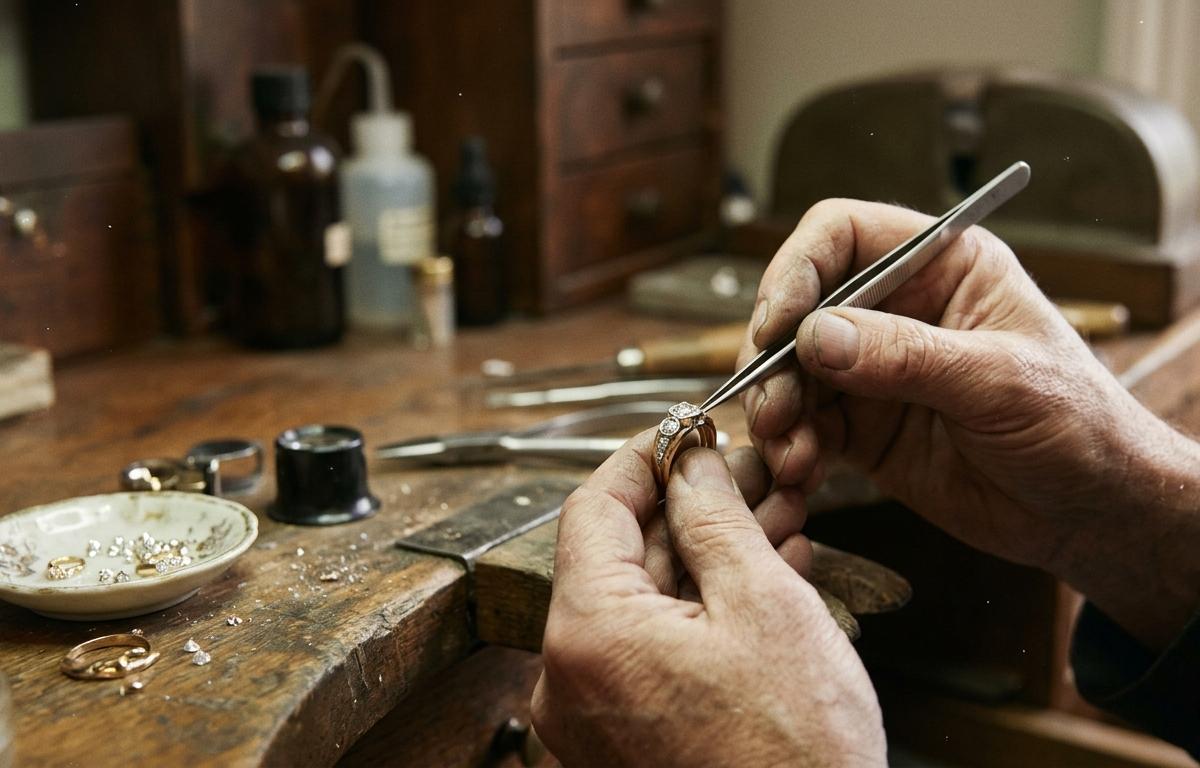
Once you approve the design, many jewelers make a wax model so you can hold the shape in your hand and check proportions before anything is cast in metal. Then the ring is crafted and finished: the stone is set, the metal is polished, and the ring is handed over.
The real payoff is control. You choose the metal, the stone, the setting and the small touches, like an engraving or a hidden accent stone. To see what’s possible, our custom jewelry designs page shows the kind of one-of-a-kind work we create here in Roseville.
How Much Does a Custom Engagement Ring Cost?
The honest answer is that it depends, and published numbers vary widely. One jeweler puts custom engagement rings at $2,500 to $12,000, with most couples landing between $5,000 and $10,000 (Billig Jewelers). Another suggests $1,500 to $7,000 (Mikado Diamonds), and a third says $3,000 to $15,000 (La Bijouterie SF). All of these figures come from jewelers, so read them as a rough landscape, not a promise. Your own quote will turn on the stone, the metal and how intricate the design is.
So what drives the price? The center stone is the biggest line item, typically about 50 to 75 percent of the total. The custom setting usually runs roughly $1,500 to $5,000, and a design or CAD fee often adds $100 to $300 (per the Billig Jewelers breakdown above). Some Bay Area jewelers charge design fees of $250 to $750 and credit that fee toward the final purchase, so ask any jeweler how theirs works before you commit.
Metal and style matter too. According to Goodstone’s 2026 cost breakdown, a 14k gold setting runs about $1,000 to $1,700, while 18k runs about $1,300 to $2,400. By style, a solitaire setting is roughly $1,000 to $3,000, a pavé setting $2,000 to $5,000 and a three-stone setting $2,000 to $7,000. More diamonds and more hand labor push the setting cost up, and fine details like milgrain or filigree add to it as well.
For context, the national average spend is reported at roughly $5,200 to $6,500 depending on the study, and The Knot’s 2026 figure is reported at $4,600 (as summarized by RoseVow). Please don’t feel bound by the old "three months’ salary" rule. The right budget is the one that lets you propose happily and still sleep well. For a deeper look at setting a number, see our guide on how much an engagement ring should cost in 2026.
How Long a Custom Ring Takes and Planning Your Proposal
Timelines vary by jeweler and by how complicated the design is. Published estimates run from two to four weeks, to three to six weeks after the design is finalized, to four to eight weeks in total. That’s a wide spread, and it tells you something useful: the clock depends on stone availability, design revisions and how busy the workshop is.
The safe rule is to start at least a month before your planned proposal, and earlier if you can. If you have a date in mind, like a birthday, an anniversary or a holiday trip, work backward from it and leave a cushion for revisions. A few things can slow you down: waiting on a specific stone to arrive, going back and forth on the design, or choosing a very detailed setting. A few things can speed you up: picking your stone early, bringing clear reference images and approving the model promptly.
What if your date is already close? You have options. A jeweler can often set a stone you’ve chosen into an existing setting much faster than building a design from scratch, which brings us to the semi-custom route below. You can also propose with a placeholder ring and present the finished custom ring afterward. Many couples find that romantic in its own right ("this is the ring I’m having made for you").
One more planning tip: get the ring size right. Resizing is simple for many styles, and we handle it right here, so see our page on ring resizing in Roseville if you’d like details. Even so, a close estimate up front saves time. If you can’t discreetly find her size, tell your jeweler, and they can build in a resizing plan.
Custom vs. Semi-Custom vs. Ready-Made: Which Fits Your Budget?
Each of these three paths has its place, and the best one depends on your timeline, your budget and how personal you want the ring to be.
Fully custom means designing from a blank page. It gives you the most freedom and the most meaning, and it’s the right choice if your partner has specific tastes, an unusual stone or a vision that no showcase ring matches. It also takes the longest and often costs more, mostly because of the design work and one-off labor.
Semi-custom starts from an existing base design and modifies it (Mikado Diamonds describes it this way). You might keep a setting you love but change the metal, swap the center stone shape, adjust the band or add a hidden halo. It’s a smart middle ground: a personal result, usually in less time and with fewer design fees than a ground-up build. Browse our engagement rings and Adam’s Bridal Collection to find a starting point worth tweaking.
Ready-made is the fastest and most predictable. You see exactly what you’re buying, take it home the same day and know the price upfront. If your partner has told you precisely what she wants, or you’re on a tight timeline, this is often the sensible choice. Our bridal selection includes designer lines such as Bellarri and Barkev’s, and many pieces can be adjusted after purchase.
So which is cheaper? There’s no universal answer. A well-chosen ready-made ring can cost less than a fully custom one with the same stone, but custom can also be tuned to your budget: choose a simpler setting, a smaller center stone or 14k instead of 18k. Decide what matters most, whether that’s uniqueness, speed or price, and let that steer you.
Heirloom Stones, Lab-Grown Options and Choosing a Trusted Local Jeweler in Roseville
Two questions come up again and again in our shop: can we use an heirloom stone, and what about lab-grown diamonds? Both fit beautifully into a custom project.
If you have a stone from a grandmother’s ring or another family piece, a custom design can reset it in a modern setting, or keep the vintage character while updating the prongs and shank. A jeweler will inspect the stone and any existing metal first, looking for chips, worn prongs or loose settings, so the new ring is built to last. Many couples tell us that using a family stone was the most meaningful choice they made. It’s a lovely way to blend past and present.
Lab-grown diamonds are another popular option. They’re chemically and visually diamonds, and they typically cost less than natural stones of the same size. One example: The Knot’s 2026 data, as reported by retailers, puts natural diamond rings at around $7,000 for about 1.6 carats versus around $4,300 for a 2.0-carat lab-grown ring. That gap can let you go larger, choose a more elaborate setting or simply spend less. Our lab-grown engagement ring buyer’s guide and loose man-made diamonds guide walk through the tradeoffs, and you can browse natural stones through our loose diamonds in Roseville page.
Choosing the right jeweler matters as much as choosing the right design. A few questions are worth asking anyone you consider. Do they offer appointments and a clear design process? Can they show you the stone’s grading paperwork? What’s their policy on design fees, revisions and credits? Do they offer financing, and do they handle resizing, repairs and appraisals after the sale? A ring is a long-term relationship, and you’ll want a team nearby for prong checks, cleaning and eventual resizing.
Adam’s Jewelers is a family-run shop serving Roseville, Rocklin, Granite Bay, Folsom, El Dorado Hills, Fair Oaks and the greater Sacramento area. We design custom pieces, repair jewelry and watches on site, offer appraisals and provide financing plans. Learn more about us on our Roseville jewelry store page, then come by with your ideas, your photos and your questions. We’d love to meet you and help you create a ring she’ll treasure for a lifetime.