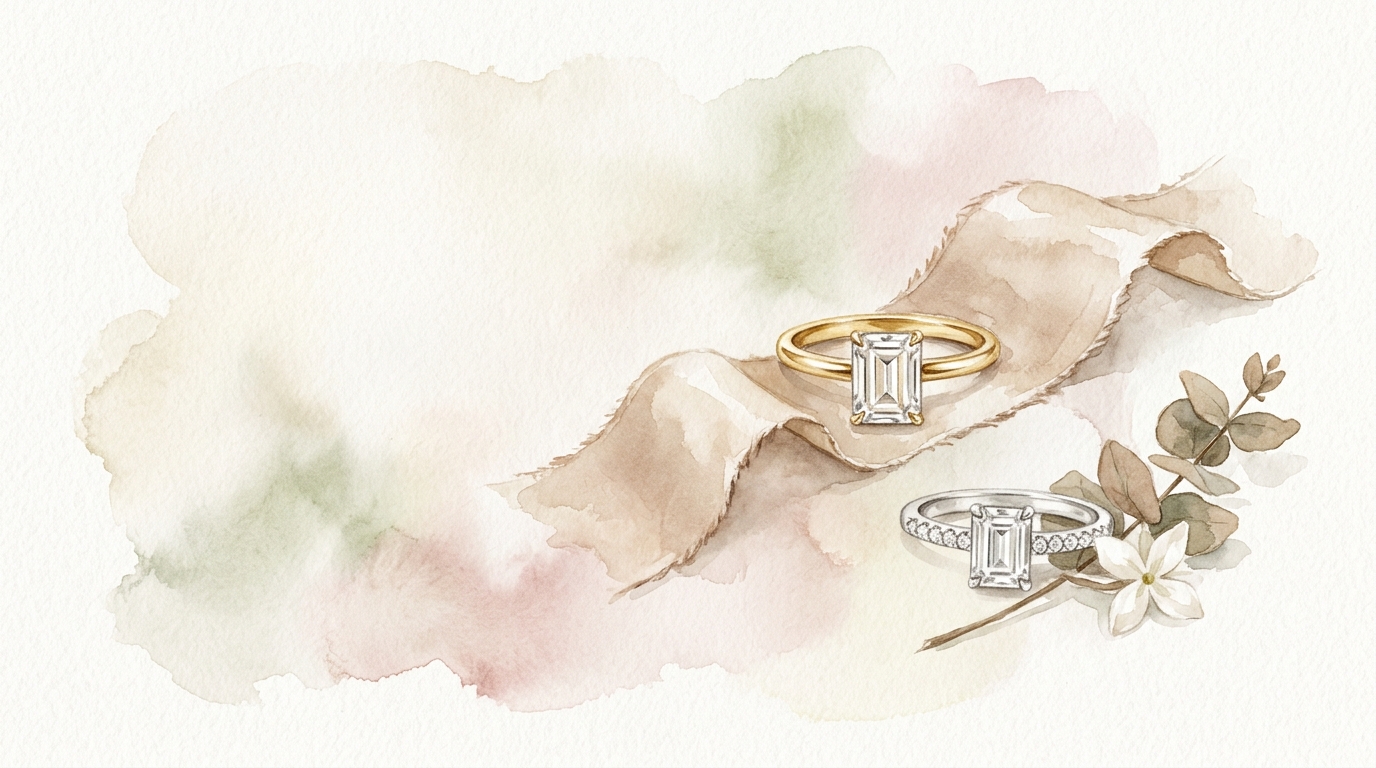
What an Emerald Cut Is and How It Looks
An emerald cut is a rectangular diamond with clipped corners and long, step-cut facets that run parallel to the edges of the stone. A round brilliant throws off confetti-style sparkle. This shape gives you broad flashes of light that slide across the stone like sunlight on still water. Gemologists call it the "hall of mirrors" effect, and it’s why the shape feels so architectural and refined. The cut puts clarity and structure front and center instead of chasing maximum sparkle, as The Diamond Collective notes in its overview of the shape.
That quiet elegance is a big part of why engagement emerald cut rings have climbed in popularity in recent years. The long lines can make a finger look slimmer and longer, and the open table gives the stone a clean, modern presence. It suits the person who’d rather have understated sophistication than glitter, and it looks just as at home in a vintage setting as a contemporary one.
One thing to know up front: because the facets are long and open, the stone is honest. Flaws have nowhere to hide, and that shapes the choices we’ll get to later on clarity and proportions. If you’re still deciding between shapes for engagement emerald cut rings, our guide to engagement ring cuts and styles lays the options out side by side.
Emerald Cut Settings Compared, and Protecting the Corners
The most common setting styles for an emerald cut are solitaire, halo, bezel, three-stone and vintage, according to Gabriel & Co.’s emerald cut collection. Each gives engagement emerald cut rings a different personality, so here’s what each does best.
A solitaire is the purest choice. It lets the stone’s clean lines do all the talking, which works well for someone who wants a timeless, minimal ring. A halo wraps the diamond in a frame of smaller stones. That adds sparkle the step cut doesn’t produce on its own and makes the center look a touch larger. A bezel circles the stone with a thin band of metal, giving a sleek, modern look and the most complete coverage. A three-stone ring flanks the center with side stones for a past, present and future story, adding presence without crowding the emerald cut. A vintage style leans on milgrain, filigree or engraved detail for an Art Deco feel, a natural match for the geometry of the shape.
Protecting the corners
The clipped corners are the most exposed part of an emerald cut, so the setting matters for everyday wear. The practical answer is protection at those four points. Corner prongs that wrap or cap the corners, or a full or partial bezel, keep the vulnerable spots shielded. A halo also creates a small buffer around the edge of the stone. Whichever you choose, ask your jeweler to show you exactly how the corners are covered, and plan on having the prongs checked now and then so a loose or worn one gets caught early. A good jeweler will gladly inspect a ring you already own, too.
Choosing Length-to-Width Ratio and Clarity in a Step Cut
Two decisions shape how an emerald cut looks on the hand more than anything else: its proportions and its clarity.
Length-to-width ratio
The ratio describes how elongated the rectangle is, and published guidance varies. The Diamond Collective gives roughly 1.30 to 1.50, while Jared says typically 1.50 to 1.75. Rather than treat any one number as a rule, think of it as a spectrum. Toward the lower end, the stone looks more classic and squarer, with a softer, balanced outline. Toward the higher end, it looks longer, sleeker and more dramatic, and tends to make fingers appear longer. Neither is "correct." It comes down to taste and to how the stone sits in your chosen setting.
The best way to decide is to see stones in person. Photos flatten proportion, and two diamonds of the same carat weight can look surprisingly different. Hold a few at different ratios against the hand and notice which one feels like her.
Clarity in a step cut
Step cuts generally show inclusions more readily than brilliant cuts, since those big open facets work like a window into the stone. That’s widely understood in the trade, but treat it as a reason to look closely, not a hard rule. Many buyers aim for a grade that looks clean to the unaided eye rather than paying for the very top of the scale, and the right answer depends on the individual stone. Two diamonds with the same grade on paper can look quite different, so examine the actual stone, ideally in good light and with a loupe, and ask your jeweler to point out any inclusions and where they sit. A tiny feature tucked near the edge or hidden under a prong can be far less noticeable than the same feature in the middle of the table.
Emerald Cut Prices: Natural, Lab-Grown and What Drives Cost
Price for engagement emerald cut rings comes down to three things: the stone, the metal and the setting style. The stone is usually the biggest share.
On the stone side, the biggest decision is natural versus lab-grown. As reported by The Knot’s 2026 data and summarized by Barkev’s, lab-grown rings average about $4,300 at 2.0 carats, while natural rings average about $7,000 at 1.6 carats. In plain terms, a lab-grown stone can get you noticeably more size for the money, which is why so many couples are choosing it. Natural stones carry the appeal of rarity and origin. Either way, carat weight, color, clarity and the quality of the cut all influence the final number, and the proportions we covered above can nudge the price too.
On the metal and setting side, Goodstone’s 2026 cost guide puts a 14k gold setting at roughly $1,000 to $1,700 and 18k at $1,300 to $2,400. By style, a solitaire runs about $1,000 to $3,000, a pavé setting $2,000 to $5,000, and a three-stone $2,000 to $7,000. Those figures cover the setting alone, not the finished ring with the center stone, and real prices vary by jeweler.
So decide where you want your budget to work hardest. Some buyers put it into a larger or cleaner stone with a simple solitaire. Others choose a slightly smaller center and invest in a detailed setting. Financing can also help spread the cost, so ask what plans are available when you shop.
Ready-Made or Custom: How the Process Works
A ready-made engagement emerald cut ring is the fastest route. You can see it, try it on, and often take it home soon after sizing. It’s a great choice when you find a setting you love and a stone that fits, and you get to judge the real thing instead of a rendering. Our engagement rings collection is a good place to start browsing.
A custom ring makes sense when you have a specific vision, want to reuse a family stone, or want a setting detail you can’t find in a case. The process typically follows these steps, as outlined in Washington Diamond’s custom design guide: a consultation, 3D modeling, stone selection, a wax model review, crafting, and final delivery. Each stage gives you a chance to refine the design before anything is permanent, and that’s the real advantage. You watch the ring take shape and can adjust prong style, band width or side stones along the way.
For an emerald cut, custom work is especially handy for fine-tuning how the corners are protected and how the stone sits, low or high on the finger. Custom takes longer than buying off the shelf, so start early if there’s a date on the calendar. If you’re weighing both paths, a quick chat with a jeweler about your budget and timeline usually makes the better route obvious.
Buying an Emerald Cut Ring Locally in Roseville and Sacramento
An emerald cut is a stone you want to see in person, and that’s the strongest argument for shopping locally. Online photos can’t show how a particular ratio looks on the hand, how a step cut catches the light, or how clean a diamond really appears to the eye. Seeing several stones side by side, in real light, is the surest way to choose with confidence.
At Adam’s Jewelers in Roseville, we’re a family-run shop serving Roseville and the greater Sacramento area, with engagement rings, loose diamonds and custom design all under one roof. We carry designer lines including Ritani, Bellarri, Barkev’s and Galatea, and our own Adam’s Bridal Collection is worth a look when you’re comparing settings. If you’re building the full set, you can also browse wedding sets and wedding and anniversary bands that sit nicely beside an emerald cut.
How to choose
When you come in, bring a few simple priorities. Settle on a rough budget and whether natural or lab-grown suits you. Think about her daily routine, since a more active lifestyle points toward a bezel or well-capped prongs. Pick a ratio range you like, then look at stones within it instead of chasing a single number. Ask to see the clarity up close, and ask how the corners will be protected. Finally, if you want something no case offers, ask about a custom design and a realistic timeline. We’re happy to walk you through every step, answer questions without pressure, and talk through financing so the ring fits both the moment and the budget.